

KLOW 80MG
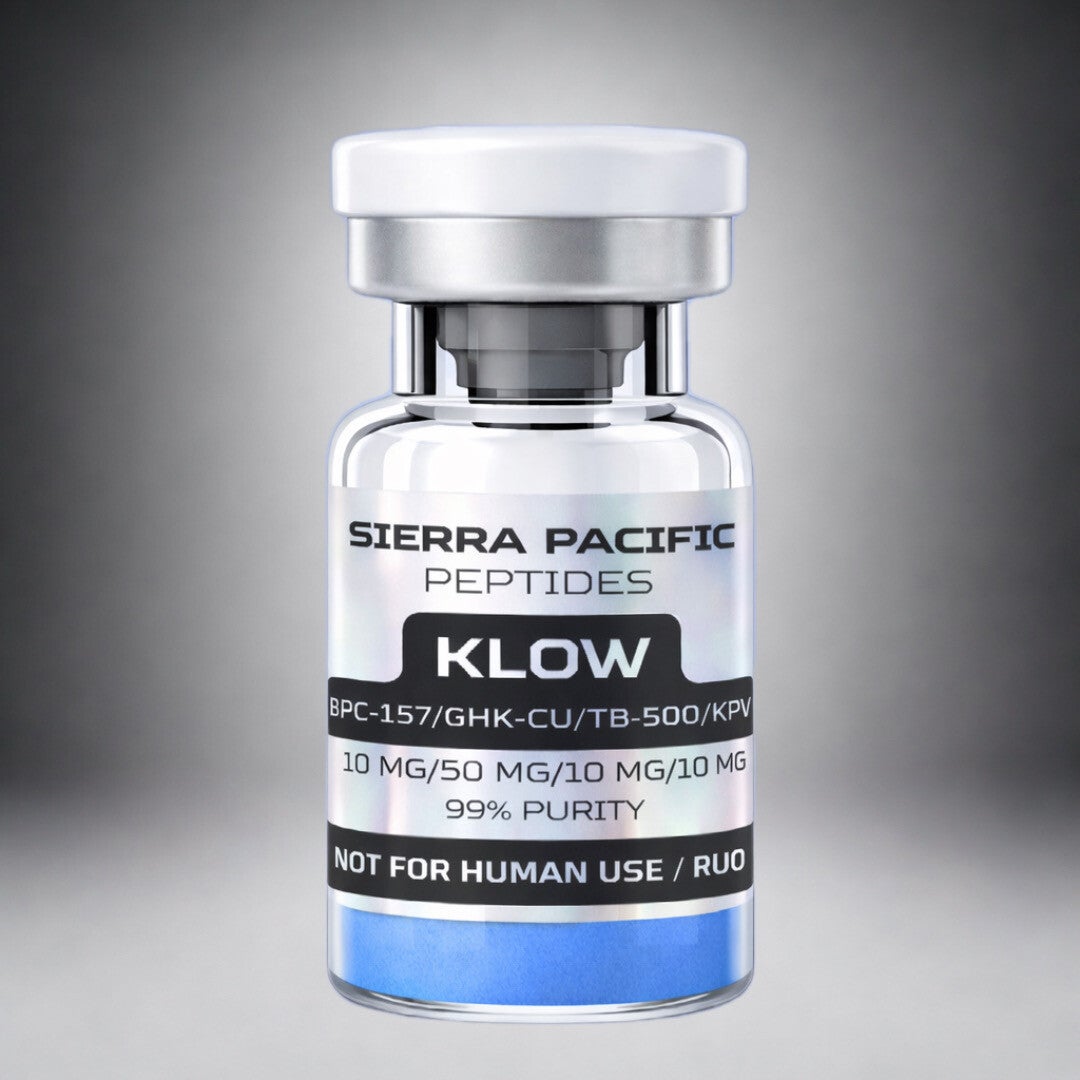

KLOW 80MG
Regenerative Peptide Blend – BPC-157, TB-500, GHK-Cu, and KPV Complex
Category: Regenerative & Anti-Inflammatory Peptide Blends
KLOW-BLEND-80MG | Form: Lyophilized Blend | Purity: ≥ 99% (HPLC Tested)
Product Overview
The KLOW Regenerative Peptide Blend combines four powerful research peptides—BPC-157, TB-500, GHK-Cu, and KPV—engineered to promote advanced recovery, tissue regeneration, and anti-inflammatory balance. This optimized blend supports cellular healing, reduces oxidative damage, and enhances skin, muscle, and connective tissue restoration. The inclusion of KPV (Lys-Pro-Val) adds an immunomodulatory component, helping to suppress pro-inflammatory cytokines while promoting epithelial repair. Together, these peptides form a comprehensive complex used in research models of regeneration, inflammation control, and systemic recovery.
Component Composition
BPC-157 (Body Protection Compound-157)
A pentadecapeptide shown to accelerate wound healing, stimulate angiogenesis, and repair tendons, ligaments, and muscle tissue.
TB-500 (Thymosin Beta-4 Fragment)
Enhances cellular migration, reduces fibrosis, and supports actin polymerization critical to tissue regeneration.
GHK-Cu (Copper Tripeptide-1)
Facilitates collagen synthesis, DNA repair, and antioxidant protection in dermal and muscular tissues.
KPV (Lys-Pro-Val)
A natural α-MSH tripeptide derivative with potent anti-inflammatory properties, reducing TNF-α and IL-6 activity while aiding epithelial regeneration.
Mechanism
Synergistically promotes angiogenesis, fibroblast activation, and immune regulation to accelerate tissue recovery and reduce inflammation.
KLOW Regenerative Blend Research Summary
The KLOW Regenerative Blend combines four peptides with complementary biological actions to target multiple pathways involved in tissue repair, inflammation control, and cellular regeneration. BPC-157 and TB-500 enhance angiogenesis and muscle recovery, GHK-Cu supports collagen remodeling and antioxidant defense, and KPV provides anti-inflammatory and epithelial protection. This multi-peptide complex has been examined for its synergistic effects on wound closure, connective tissue health, and oxidative resilience.
Key research findings include:
- BPC-157 promotes tendon-to-bone healing and angiogenesis in animal models (J Orthop Res, 2009).
- TB-500 increases cell migration and reduces inflammation post-injury (Ann N Y Acad Sci, 2012).
- GHK-Cu upregulates collagen and glycosaminoglycan synthesis, supporting dermal repair (J Invest Dermatol, 2005).
- KPV suppresses intestinal and systemic inflammation by modulating NF-κB pathways (Peptides, 2016).
- Combined multi-peptide research shows enhanced regenerative and anti-inflammatory synergy (Front Pharmacol, 2022).
These findings underscore KLOW’s role as a comprehensive regenerative research blend ideal for studying integrated tissue healing and inflammation modulation.
Applications in Research
- Tissue and wound healing models
- Muscle, tendon, and ligament recovery research
- Skin regeneration and collagen remodeling studies
- Anti-inflammatory and oxidative stress reduction assays
- Angiogenesis and fibroblast migration investigations
For Research Use Only
This peptide blend is intended solely for laboratory and preclinical research. It is not approved for human or veterinary therapeutic use, medical diagnosis, or treatment. Researchers must comply with institutional biosafety and peptide-handling regulations when using this compound.
References
- Sikiric P. et al. 'Angiogenic and Regenerative Potential of BPC-157.' Journal of Orthopaedic Research, 2009.
- Goldstein AL. et al. 'Thymosin Beta-4 Derivatives in Tissue Repair and Regeneration.' Annals of the New York Academy of Sciences, 2012.
- Pickart L. et al. 'Copper Peptide Complexes in Collagen Remodeling and Wound Repair.' Journal of Investigative Dermatology, 2005.
- Singh PK. et al. 'Anti-Inflammatory Mechanisms of KPV Peptide via NF-κB Pathway Suppression.' Peptides, 2016.
- Wang J. et al. 'Synergistic Regenerative Effects of Multi-Peptide Complexes.' Frontiers in Pharmacology, 2022.